
Bitcoin Failed as Money: The Economic Case Against Crypto’s Biggest Narrative
Did Bitcoin fail in its original mission? This deep analysis explores Bitcoin’s volatility, the El Salvador experiment, the Greater Fool Theory, institutional adoption, and why critics argue crypto became a speculative asset instead of a true currency.
5/10/20265 min read
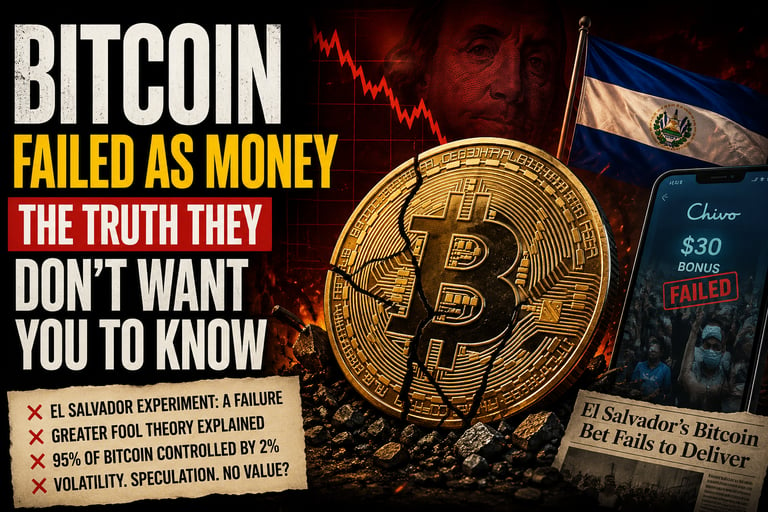
Bitcoin Failed as Money — But Became the World’s Biggest Speculative Asset
For years, Bitcoin was marketed as the future of money: decentralized, borderless, inflation-resistant, and free from government control. Its supporters claimed it would replace banks, challenge fiat currencies, and become a revolutionary global payment system.
Yet more than fifteen years after the original white paper by Satoshi Nakamoto, a growing number of economists, investors, and financial analysts argue that Bitcoin has fundamentally failed in its original mission.
Instead of becoming a true currency, Bitcoin may have evolved into something entirely different: a highly speculative digital asset driven more by narratives, momentum, and investor psychology than by real-world utility.
The question is no longer whether Bitcoin is revolutionary. The real question is whether it ever solved the problems it promised to fix.
The Original Promise Behind Bitcoin
In 2008, during the global financial crisis, Satoshi Nakamoto introduced Bitcoin as a peer-to-peer electronic cash system designed to eliminate the need for banks and centralized financial intermediaries.
The vision was powerful:
direct payments between individuals
decentralized monetary control
low transaction costs
protection from inflationary governments
financial freedom outside the traditional banking system
At the time, the idea resonated deeply, especially in North America and Europe, where distrust in banks surged after the collapse of major financial institutions during the Global Financial Crisis.
But critics argue that Bitcoin ultimately failed to become what it originally promised: usable digital money.
Why Critics Say Bitcoin Failed as a Currency
Economists generally define money through three essential functions:
Medium of exchange
Store of value
Unit of account
According to critics of Bitcoin, the cryptocurrency struggles in all three areas.
1. Bitcoin Struggles as a Medium of Exchange
Bitcoin was designed to function as digital cash, yet in practice it remains difficult to use for daily transactions at scale.
Critics point out several issues:
slow transaction speeds
network congestion
high transaction fees during periods of heavy activity
massive energy consumption compared to traditional payment systems
While payment giants like Visa process tens of thousands of transactions per second, Bitcoin’s network remains significantly slower and less efficient for mainstream commerce.
Even many businesses that accept Bitcoin rarely keep it on their balance sheets. Instead, transactions are usually converted immediately into U.S. dollars or euros.
That creates an uncomfortable reality for Bitcoin advocates:
the system often functions less like money and more like a speculative payment layer sitting on top of fiat currencies.
2. Bitcoin’s Extreme Volatility Weakens Its Role as a Store of Value
Supporters frequently describe Bitcoin as “digital gold.” Critics strongly disagree. A reliable store of value should preserve purchasing power with relative stability over time. Bitcoin, however, has experienced massive price swings throughout its history. 20% monthly price movements are not uncommon.
For institutions, businesses, and consumers, that volatility creates a major problem:
nobody wants their purchasing power changing dramatically within days or weeks.
This instability has prevented Bitcoin from functioning like traditional safe-haven assets such as:
gold
U.S. Treasury bonds
reserve currencies like the U.S. dollar
Instead, Bitcoin increasingly behaves like a high-risk technology stock driven by speculation and market sentiment.
The Concentration Problem Nobody Likes to Discuss
One of the strongest criticisms against Bitcoin’s “decentralized” narrative is the concentration of ownership.
Critics argue that a surprisingly small percentage of wallets controls most of the Bitcoin supply, creating a highly uneven ecosystem where large holders — commonly called whales — can exert enormous influence over price movements.
That concentration raises concerns about:
price manipulation
liquidity shocks
coordinated selling pressure
systemic fragility
For an asset marketed as democratized finance, critics believe the ownership structure often resembles the same wealth concentration seen in traditional financial systems.
The El Salvador Experiment: A Real-World Stress Test
In 2021, El Salvador became the first country in the world to adopt Bitcoin as legal tender.
The move attracted global attention.
President Nayib Bukele promoted Bitcoin as a tool for:
financial inclusion
cheaper remittances
reduced dependence on banks
economic modernization
The government launched the Chivo wallet and offered citizens a $30 Bitcoin bonus for signing up.
Initially, crypto supporters celebrated the move as the beginning of a monetary revolution.
But critics argue the results tell a different story.
Why Critics Call El Salvador’s Bitcoin Strategy a Failure
According to multiple reports and surveys referenced by Bitcoin skeptics:
adoption rates remained low
most remittances continued using traditional financial systems
many citizens stopped using the Chivo wallet shortly after claiming the $30 incentive
large parts of the population expressed skepticism toward the project
For critics, El Salvador became the first large-scale real-world test of Bitcoin as national currency — and the outcome exposed major weaknesses in adoption and usability.
The experiment also highlighted a broader issue:
people generally prefer stable currencies over volatile assets for everyday economic activity.
The Greater Fool Theory and the Bitcoin Debate
One of the harshest criticisms of Bitcoin revolves around the so-called Greater Fool Theory.
The theory suggests that an asset can continue rising in value not because of intrinsic usefulness, but because investors believe someone else will buy it later at a higher price.
Critics argue this dynamic dominates the cryptocurrency market. Unlike stocks, Bitcoin does not generate:
earnings
dividends
cash flow
industrial output
Its price therefore depends almost entirely on investor demand and market psychology.
Supporters argue scarcity alone gives Bitcoin value. Critics counter that scarcity without utility does not automatically create sustainable economic worth. This debate remains one of the most controversial topics in modern finance.
Why Bitcoin Narratives Constantly Change
Over the years, Bitcoin has been described as:
digital gold
inflation hedge
future of money
banking alternative
store of value
safe haven asset
anti-government currency
Critics argue these narratives frequently shift because Bitcoin struggles to consistently fulfill any single economic role.
For example:
during inflation spikes, Bitcoin was marketed as inflation protection
during banking crises, it became “financial freedom”
during bull markets, it was called “digital gold”
during institutional adoption waves, it became a Wall Street asset
Skeptics believe this constant narrative evolution reflects an asset searching for a permanent identity.
Bitcoin’s Biggest Contradiction
Ironically, Bitcoin’s survival may depend on the exact financial system it originally tried to replace.
Today, much of Bitcoin’s growth comes from:
institutional investors
ETFs
hedge funds
Wall Street trading firms
speculative capital flows
That creates a major contradiction: the more institutionalized Bitcoin becomes, the less revolutionary it appears. Instead of replacing the traditional financial system, Bitcoin may simply be integrating into it.
Is Bitcoin a Scam — Or Just a Speculative Asset?
Calling Bitcoin a “scam” remains controversial.
Unlike fraudulent schemes, Bitcoin operates on open-source technology with transparent blockchain records.
However, critics argue that many promises surrounding Bitcoin were exaggerated:
mass adoption as money
mainstream payment utility
decentralization
financial democratization
What emerged instead may be a global speculative asset fueled by volatility, media cycles, and investor psychology. Even some critics admit Bitcoin could continue rising in price for years.
But they argue price appreciation alone does not prove economic utility.
Final Thoughts
Bitcoin may never become the decentralized global currency envisioned in 2008. But that does not necessarily mean it disappears.
Instead, Bitcoin appears to be evolving into something entirely different:
a speculative macro asset sitting somewhere between technology, finance, ideology, and digital scarcity. Its supporters still see a monetary revolution.
Its critics see one of the largest speculative experiments in modern history. And perhaps that is the real story behind Bitcoin: not the future of money — but the future of speculation itself.
Recommended Reading
For readers interested in understanding speculative bubbles, financial manias, and market psychology, one of the best books to start with is:
Extraordinary Popular Delusions and the Madness of Crowds
Despite being written in the 19th century, the book remains remarkably relevant to modern speculative markets, including cryptocurrencies.
Link: https://amzn.to/4wlDTrg