
Bitcoin Crash Below $60K: Why AI, the Fed, and Wall Street’s Capital Rotation Are Shaking Crypto Markets
Bitcoin has fallen below $60,000, but the real story goes far beyond crypto. Discover how AI investment mania, Federal Reserve policy, institutional capital rotation, and rising cybersecurity fears are reshaping the future of Bitcoin and global markets.
6/7/20265 min read
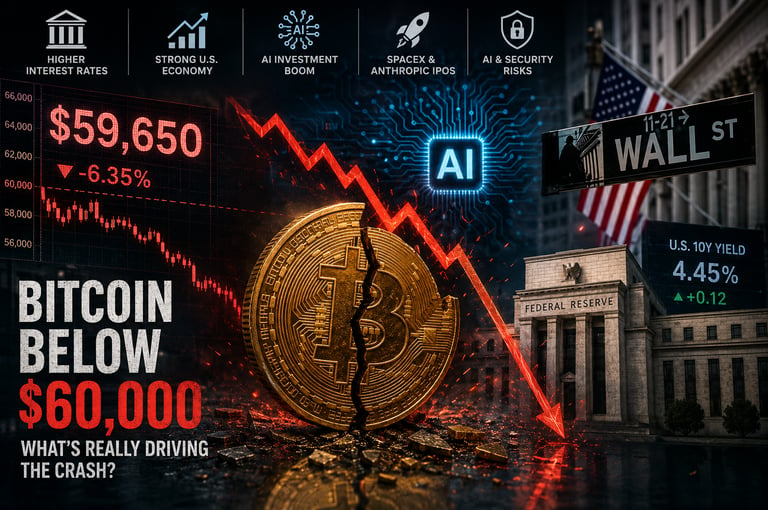
Bitcoin’s Collapse Below $60,000 Is Not About Bitcoin — It’s About a Global Capital Rotation
Crypto Panic Is Back. But Investors Are Looking in the Wrong Direction.
Bitcoin breaking below the psychologically important $60,000 level has triggered another wave of panic across financial markets. Headlines are screaming. Social media is flooded with predictions of collapse. Traders are debating whether this marks the beginning of another crypto winter.
But the evidence suggests that Bitcoin's latest decline is less about a failure of the cryptocurrency itself and more about something much larger: a historic rotation of global capital.
A boots-on-the-ground perspective reveals a market struggling to absorb multiple shocks simultaneously:
Higher-for-longer interest rates
Stronger-than-expected U.S. economic data
Massive liquidity demands from upcoming AI-related opportunities
Growing concerns surrounding artificial intelligence and cybersecurity
Investor fatigue after years of volatile crypto cycles
Bitcoin is simply becoming collateral damage in a broader battle for capital.
The Death of the "BlackRock Will Save Bitcoin" Narrative
One of the strongest bullish narratives of the past two years was simple: "If Wall Street enters Bitcoin, Bitcoin will never experience another deep correction."
The arrival of institutional giants was supposed to eliminate volatility. Reality has delivered a different lesson.
Despite ETF adoption and institutional participation, Bitcoin has once again demonstrated a brutal truth that experienced investors already know: Markets do not become immune to fear simply because large institutions participate.
In fact, institutions often accelerate volatility because they allocate capital based on opportunity costs. When a potentially superior opportunity emerges, capital moves and right now, investors believe they are witnessing the biggest investment boom since the internet.
The AI Gold Rush Is Draining Liquidity From Crypto
The most overlooked factor behind Bitcoin's weakness is the explosive rise of artificial intelligence.
For the first time since the emergence of Bitcoin as an investable asset, crypto faces a direct competitor for speculative capital.
The AI sector has become the new magnet for growth investors.
Major private-market opportunities are attracting enormous attention:
SpaceX secondary offerings and IPO speculation
Anthropic fundraising rounds
AI infrastructure companies
Data center expansion projects
Semiconductor manufacturers
AI software platforms
The capital that once flowed almost exclusively into crypto is now being redirected toward AI.
Michael Saylor recently argued that Bitcoin's decline reflects this capital rotation. While many dismissed the claim, there is substantial logic behind it.
Investors chasing exponential returns are increasingly viewing AI as the next frontier. In markets, money follows momentum. And momentum currently belongs to artificial intelligence.
The Federal Reserve Is Still the Most Important Variable
Crypto investors often underestimate how dependent Bitcoin remains on monetary conditions.
The latest employment data from the United States reinforced a growing concern: The American economy remains stronger than expected. That sounds positive. For financial markets, however, strong economic data creates a problem.
A resilient labor market means:
Inflation risks remain elevated
The Federal Reserve has less urgency to cut rates
Treasury yields stay higher
Liquidity remains constrained
Every asset class that depends on abundant liquidity suffers under this environment. Bitcoin is no exception.
The popular narrative that Bitcoin is completely detached from traditional financial conditions continues to collide with reality.
When interest rates rise, speculative assets struggle. The current market environment is proving that once again.
The Michael Saylor Problem Is Not Financial — It's Psychological
A surprisingly controversial issue emerged when Michael Saylor sold a small amount of Bitcoin.
Financially, the sale was insignificant. Compared to the enormous Bitcoin reserves controlled by his company, the transaction barely matters.
But markets are not driven purely by mathematics. They are driven by narratives.
For years, Saylor became the symbol of an uncompromising message: "Never sell your Bitcoin."
When someone who embodies that philosophy sells, even on a small scale, investors begin questioning the conviction behind the narrative.
The market reaction is therefore less about supply and demand and more about trust. The issue is symbolic and symbols matter during periods of uncertainty.
A New Threat Emerges: Artificial Intelligence vs. Cryptography
Perhaps the most fascinating development is the growing intersection between AI and cybersecurity.
Recent reports involving vulnerabilities discovered in established cryptocurrency projects have reignited an uncomfortable debate: What happens when AI becomes powerful enough to identify weaknesses in cryptographic systems faster than humans can defend them?
The concern is no longer theoretical. Advanced AI models are already assisting researchers in discovering software vulnerabilities at unprecedented speed.
This does not mean Bitcoin is about to be hacked. Far from it.
However, the market is beginning to price a future in which:
AI accelerates vulnerability discovery
Quantum computing advances continue
Digital security becomes an arms race
Ironically, the same technological revolution creating trillion-dollar opportunities could eventually challenge the foundations of digital finance itself.
Investors should not panic. But they should pay attention.
Why Bitcoin Could Still Experience Another Violent Downside Move
The uncomfortable reality is that Bitcoin has experienced multiple periods where investors waited years merely to break even.
Many market participants who bought near previous peaks are once again facing stagnant returns. That creates a dangerous psychological setup.
When investors become frustrated, they stop viewing dips as opportunities and begin viewing them as confirmation that they made a mistake.
This transition from hope to exhaustion often creates the final stages of major corrections. The evidence suggests Bitcoin could still experience another significant drawdown before establishing a durable bottom.
Whether that level is $50,000, $40,000, or even lower is impossible to predict with confidence.
What matters is understanding that market bottoms are usually formed through emotional capitulation rather than rational analysis.
The Bigger Picture: This Is a Liquidity Story, Not a Crypto Story
Many investors are making the mistake of searching for Bitcoin-specific explanations. The broader picture tells a different story.
Today, nearly every risk asset is competing for capital in an environment defined by:
Elevated interest rates
Massive AI investment opportunities
Increased geopolitical uncertainty
Tighter financial conditions
Shifting investor psychology
Bitcoin's decline is not occurring in isolation.
It is occurring during one of the most aggressive reallocations of capital seen in modern markets. That distinction matters.
Because if the problem is liquidity rather than Bitcoin itself, the eventual recovery could be equally powerful once financial conditions improve.
For long-term investors, the key question is not whether Bitcoin is falling. The key question is whether they possess the conviction — and the risk tolerance — to survive the volatility that has always defined the asset.
Final Thoughts
History shows that the greatest opportunities in financial markets rarely appear when confidence is high. They emerge when fear dominates headlines and investors begin questioning everything they previously believed.
Bitcoin's break below $60,000 may ultimately be remembered not as the start of a permanent collapse, but as a chapter in a much larger transition of global capital from one speculative frontier to another.
The battle today is no longer Bitcoin versus traditional finance. It is Bitcoin versus artificial intelligence for the world's most aggressive investment dollars.
For readers seeking a deeper understanding of speculative cycles, technological disruption, and investor psychology, one highly recommended book is The Psychology of Money by Morgan Housel. Its lessons on behavior, patience, and market cycles are particularly relevant during periods like the one we are witnessing today.