
Billion-Dollar Crypto Hacks: Why the Blockchain Isn’t the Problem
While institutional capital floods the market, billion-dollar attacks expose the fragility of Web3's outer layers. This analysis deconstructs the myth that "Blockchain has failed," revealing that the real danger lies within bridges and peripheral protocols. Understand why the sector's maturity requires more than just capital: it demands a re-engineering of trust and technical education for investors.
5/2/20262 min read
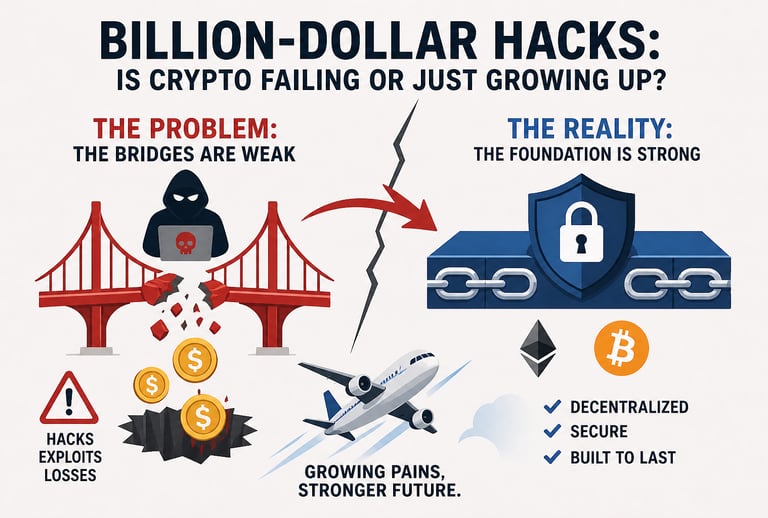
Billion-Dollar Hacks: Is Crypto Failing or Just Growing Up?
The headlines are terrifying: billions of dollars vanishing into the digital void. For the casual observer, it looks like a house of cards. For the 2t Economics reader, however, it’s a masterclass in market evolution and infrastructure stress-testing.
The recent wave of high-profile attacks has reignited the debate: Can we actually trust the blockchain? To answer that, we need to stop looking at the "base" and start looking at the "bridges."
1. The Core is Solid; The Periphery is Leaking
A common misconception among retail investors—and even some institutional players—is that a hack means the "Blockchain" was compromised. This is factually incorrect.
As noted by Pedro Xavier (CEO of Mannah), the core structures of major networks like Ethereum remain virtually unhackable due to their decentralized nature. The vulnerability lies in the Layer 2 protocols and third-party applications built on top of them.
Think of it like this: If a bank is robbed because someone left the back door of the security van open, you don't blame the currency or the central bank's vault. You blame the logistics company. In crypto, the "security vans" are the protocols and bridges.
2. The "Bridge" Problem: A Hacker’s Paradise
The most sophisticated attacks today target Bridges—the systems that allow you to move assets between different networks (e.g., Ethereum to Solana).
Because these bridges require external verification systems (like smart contracts or even facial recognition/API calls), they create a "surface of attack." Hackers don't try to break the vault; they intercept the armored truck during the transfer. The complexity of cross-chain communication is currently the biggest operational risk in the ecosystem.
3. The Aviation Analogy: Growing Pains
Xavier uses a powerful analogy: Does a plane crash disqualify the entire aviation industry? Of course not. Does a building collapse mean we should stop using concrete? No.
The crypto sector is experiencing its "1920s aviation" phase. We are seeing structural failures because the industry is moving at light speed. These "accidents" lead to better regulations, tougher code audits, and more resilient systems. The sector isn't in check; it’s being refined through fire.
4. Institutional Entry: More Money, More Targets
There is a paradox in the current market: the entry of giants like BlackRock and Fidelity brings legitimacy, but it also brings a "bounty" that is too big for cybercriminals to ignore.
The Risk: More liquidity means more incentive for high-level state-sponsored hackers.
The Solution: The transition from "move fast and break things" to "institutional-grade security" is no longer optional.
The 2t Analysis:
As an investor, you shouldn't fear the hacks; you should fear lack of education. Most losses occur because users don't understand the difference between holding assets in a "Cold Wallet" versus leaving them in a "Bridge Protocol" for yield.
The Verdict: We are witnessing a "Darwinian" event in finance. Protocols with weak security will be wiped out, and the ones that survive will form the backbone of the future global financial system. The "Jackhammer Economy" isn't just about gold and inflation—it's about which digital assets are strong enough to withstand the assault.