
Beyond Taiwan: Why the Strait of Malacca is China’s True Achilles’ Heel
The South China Sea is no longer just a diplomatic dispute; it is a $3 trillion economic choke point. As China constructs 'unsinkable aircraft carriers' through artificial islands to secure its 51% maritime export share, the U.S. and its allies are tightening the noose at the Strait of Malacca. For the global investor, the 'Malacca Dilemma' represents the ultimate asymmetric risk. This is the frontline of World War III, and the victor will be decided by who controls the water first.
4/26/20263 min read
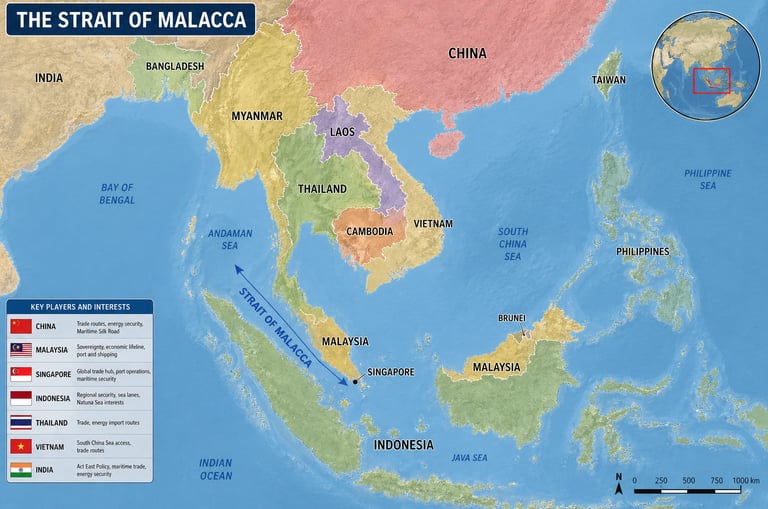
The Malacca Stranglehold: Is the US-Indonesia Pact a Death Sentence for Chinese Trade?
A boots-on-the-ground perspective reveals that the most dangerous place on Earth isn't a land border—it’s a stretch of saltwater. The South China Sea has become a theater of "calculated friction" where the national interests of Vietnam, the Philippines, Malaysia, and Brunei collide with Beijing’s "Nine-Dash Line" ambition.
But while the media focuses on the diplomatic shouting match at the UN, Wall Street and global strategists are watching the Strait of Malacca. This is the "checkmate" move in the global chess game.
The Great Wall of Sand: China’s Desperate Moat
Since 1947, Beijing has claimed total sovereignty over these waters. Having failed to gain international recognition, they’ve turned to engineering what they couldn't win through law.
Artificial Sovereignty: China is using massive maritime machinery to dredge the ocean floor, creating islands out of thin air.
Fortified Atolls: These aren't tourist destinations. They are high-tech military bases equipped with heavy firepower, specifically placed to disrupt U.S. Navy patrols.
The Motive: 51% of Chinese exports move by sea. Without control of this perimeter, China’s "cheap labor" advantage evaporates under the weight of maritime blockades and sky-high insurance premiums.
The "Malacca Dilemma": Beijing’s Achilles' Heel
The evidence suggests that China’s rapid growth has exposed its greatest vulnerability: The Strait of Malacca. This narrow corridor between the Malay Peninsula and Sumatra is the shortest route connecting Europe, the Middle East, and Africa to East Asia.
The $3 Trillion Funnel: Over 30% of world trade and 15 million barrels of oil per day flow through this needle’s eye.
The Fuel Crisis Scenario: 80% of China’s fuel imports pass through Malacca. If a Western-allied force—backed by U.S. bases in Japan and Australia—blocks this passage, the Chinese economy doesn't just slow down; it collapses in weeks.
Financial Impact: A total blockade would cost the Chinese government approximately $5 million per day in immediate trade loss, followed by a systemic banking collapse as manufacturing lines freeze.
Skin in the Game: Why the Global Investor Should Care
As an investor, you cannot ignore the "geopolitical tax" that a conflict here would impose. The South China Sea is the "plumbing" of the global market.
Supply Chain Contagion: Everything from semiconductors to consumer goods is audited and audited again by the stability of this route.
The Taiwan Multiplier: The looming threat of a Taiwan invasion is inextricably linked to Malacca. China cannot afford to move on Taiwan if its energy lifeline in Malacca is held by U.S.-allied forces.
Audit of Risk: We are seeing a strategic "encirclement." U.S. forces in Okinawa and Australia are no longer just "present"—they are positioned to squeeze.
Analyst’s Verdict: The nation that dictates the rules of passage through Malacca dictates the global economy. For China, this is a fight for survival. For the U.S., it is a fight for continued hegemony. For the investor, it is the highest-conviction reason to diversify out of direct Chinese exposure and into the "Defense and Infrastructure" of America’s Pacific allies.
Tactical Intelligence: Decoding Beijing's Maritime Ambitions
To truly understand the 'Malacca Dilemma,' you must look at the blueprint China is using to reshape the world's oceans. 'The 21st Century Maritime Silk Road (Contemporary Issues in the South China Sea)' is the definitive guide for institutional investors and macro analysts who need to look past the headlines. This book breaks down the complex intersection of maritime law, infrastructure investments, and security challenges that define the South China Sea today. In a market where information is everywhere but insight is rare, this is the deep-dive intelligence you need to understand how Beijing plans to secure its 51% trade share and bypass global choke points. For those with skin in the game, this isn't just a book—it’s a map of the coming decade's economic battlefield. Support our research at 2t Economics by securing your copy through the link below:
👉 Get 'The 21st Century Maritime Silk Road' on Amazon here
Keywords:South China Sea Geopolitics, Strait of Malacca Trade, China Economic Collapse Risk, Nine-Dash Line Conflict, US Navy Pacific Strategy, Global Supply Chain Bottlenecks, Artificial Island Military Bases, 2t Economics Macro Analysis, Maritime Energy Security