
Best Dividend ETFs: Building a Dollar Income Portfolio with U.S. ETFs
Discover the best dividend ETFs for 2026 and learn how to build a diversified U.S. dollar income portfolio for long-term growth.
5/24/20265 min read

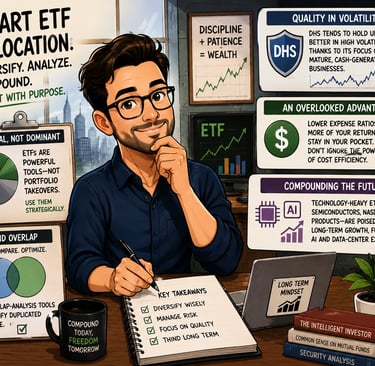
Building a Dollar Dividend ETF Portfolio in 2026: Income, AI Exposure, and the Global Search for Yield
The global investment landscape in 2026 continues to favor U.S. capital markets. While valuations across major American equity indices remain elevated, the structural drivers behind U.S. asset dominance — artificial intelligence infrastructure, semiconductor demand, resilient consumer spending, and dollar strength — continue to attract international investors seeking both capital appreciation and hard-currency income.
For long-term investors, dividend-focused ETFs have increasingly become a hybrid solution: combining equity exposure, sector diversification, and recurring dollar-denominated cash flow. In an era defined by persistent inflation uncertainty, geopolitical fragmentation, and shifting Federal Reserve policy expectations, the appeal of receiving monthly or quarterly income in U.S. dollars has become strategically relevant — especially for investors outside the United States.
The core thesis presented in the source material is straightforward:
Use ETFs as low-cost diversification vehicles
Blend growth-oriented U.S. equity exposure with income-generating dividend strategies
Maintain a structured allocation framework
Use cash-like instruments tactically during market drawdowns
Avoid excessive concentration through overlap analysis
Rather than promoting speculative stock-picking, the framework advocates systematic exposure to high-quality U.S. assets with a long-duration mindset.
Why Dividend ETFs Remain Attractive in 2026
The popularity of dividend ETFs reflects a broader macro trend: investors increasingly want income without abandoning equity upside.
Unlike traditional fixed income instruments, dividend ETFs provide:
Exposure to corporate earnings growth
Participation in long-term equity appreciation
Recurring cash distributions
Sector diversification
Lower single-stock risk
The appeal becomes even stronger when combined with U.S. dollar exposure.
For international investors, returns are driven by two variables:
The appreciation of the ETF itself
The performance of the U.S. dollar against the local currency
This dual-engine return profile has historically amplified gains during periods of dollar strength and U.S. equity outperformance.
Technology-heavy ETFs illustrate long-term compounding potential, particularly semiconductor and Nasdaq-linked products benefiting from AI and data-center expansion.
Key structural themes include:
Artificial intelligence infrastructure
Semiconductor demand
Cloud computing
Digital productivity
Big Tech cash-flow dominance
These sectors continue to dominate U.S. index performance in 2026.
Understanding ETFs as Portfolio Infrastructure
An ETF (Exchange-Traded Fund) functions as a rules-based investment vehicle that holds baskets of assets — typically stocks, REITs, bonds, or thematic exposures.
Most ETFs replicate an index through predefined selection criteria, including:
Market capitalization
Dividend consistency
Volatility screens
Sector weighting
Profitability requirements
This allows investors to gain diversified exposure through a single instrument while avoiding the operational complexity of building dozens of individual positions.
A key advantage often overlooked by retail investors is that ETFs reduce the risk of selecting the wrong individual winner within a strong sector.
ETFs reduce the risk of selecting the wrong individual winner within a strong sector.
This is especially relevant in rapidly evolving industries like semiconductors and AI infrastructure, where long-term leaders can shift unexpectedly.
The Strategic Case for U.S. Dividend ETFs
The portfolio framework focuses on balancing three objectives:
1. Long-Term Capital Growth
Broad-market and technology-heavy ETFs provide structural exposure to U.S. corporate growth.
2. Dollar-Denominated Income
Monthly or quarterly dividends create recurring cash flow in hard currency.
3. Risk Distribution
Diversification across hundreds of companies reduces concentration risk.
The approach reflects a classic “core + income overlay” strategy increasingly popular among global retail investors.
Featured Dividend ETFs and Their Strategic Roles
DHS — High Dividend Equity Exposure
The DHS ETF is positioned as a core dividend-income vehicle.
Key characteristics:
Focus on companies with strong and consistent dividend payments
Monthly dividend distributions
Approximately 4.4% annual dividend yield
Exposure to hundreds of dividend-paying equities
DHS tends to perform relatively well during periods of elevated volatility due to its focus on mature, cash-generating businesses.
SPHD — Low Volatility Dividend Strategy
SPHD combines dividend income with low-volatility screening.
Key features:
Focus on lower-volatility stocks within the S&P 500
Monthly income distributions
Roughly 5% dividend yield
Equal-weight style diversification
This structure appeals to investors seeking smoother equity exposure while still maintaining meaningful income generation.
NOBL — Dividend Aristocrat Exposure
NOBL focuses on companies with exceptionally long dividend histories.
Selection criteria include:
Minimum 25 years of consecutive dividend growth
Broad diversification across sectors
Quarterly dividend payments
This ETF reflects a more defensive, quality-oriented strategy centered on durable cash-flow businesses.
Its lower yield relative to other dividend ETFs is offset by historically stronger balance-sheet quality and stability.
VYM — Broad High-Yield Diversification
VYM represents a lower-cost approach to broad dividend exposure.
Key characteristics:
Very low expense ratio
Exposure to more than 600 holdings
Emphasis on above-average dividend-paying companies
Compared with more aggressive income ETFs, VYM offers a stronger balance between dividend yield and long-term capital appreciation.
The Rise of Options-Based Income ETFs
One of the more important developments in modern ETF markets has been the rapid growth of covered-call and derivative-enhanced income products. Two major ETFs stand out in this category:s:
JEPI — Equity Premium Income
Managed by JPMorgan Chase & Co., JEPI combines:
S&P 500 equity exposure
Options overlays
Enhanced income generation
The ETF currently offers substantially higher yields than traditional dividend products, but introduces additional complexity and risk.
Derivative strategies can boost income
Active management introduces execution risk
Long-term upside may be capped during strong bull markets
This is a critical distinction often misunderstood by retail investors chasing headline yields.
JEPQ — Nasdaq Income Strategy
JEPQ applies a similar structure to Nasdaq-focused equities.
This increases exposure to:
Big Tech
AI leaders
Semiconductor firms
Higher-volatility growth equities
The trade-off is clear:
Higher potential income
Higher concentration risk
Greater sensitivity to technology cycles
These ETFs are better treated as tactical allocations rather than dominant portfolio positions.
Overlap Risk: A Critical but Overlooked ETF Problem
One of the strongest analytical points in the discussion involves ETF overlap analysis. Many investors believe they are diversified simply because they own multiple ETFs. In reality, several dividend funds hold substantial positions in the same mega-cap companies.
This creates hidden concentration risk. Overlap-analysis tools can help investors compare ETF holdings and identify duplicated exposure.
The broader lesson is important: Owning multiple ETFs does not automatically equal diversification.
In the current U.S. market environment, many supposedly diversified products remain heavily concentrated in:
NVIDIA Corporation
Apple Inc.
Alphabet Inc.
Microsoft Corporation
As AI-driven concentration intensifies across indices, overlap analysis becomes increasingly important.
Constructing a Practical Dividend ETF Portfolio
The proposed portfolio structure follows a layered framework.
Core Allocation
Broad-market exposure through:
S&P 500 ETFs
Nasdaq growth ETFs
Purpose:
Long-term capital appreciation
Structural exposure to U.S. economic leadership
Dividend Layer
Income-focused ETFs such as:
DHS
SPHD
NOBL
VYM
Purpose:
Recurring income
Lower volatility
Cash-flow generation
Tactical High-Yield Layer
Smaller allocations to:
JEPI
JEPQ
Purpose:
Enhanced yield
Tactical income generation
Stresses position sizing as the main risk-control mechanism. This is a key institutional principle: Higher-risk products are not inherently problematic if exposure remains appropriately limited.
The Importance of Cash and Liquidity Reserves
A notable feature of the proposed strategy is the inclusion of short-duration Treasury exposure via cash-like ETFs.
The logic is tactical rather than return-seeking.
Cash reserves allow investors to:
Buy during corrections
Reduce forced selling
Maintain psychological discipline
Rebalance efficiently
In macro terms, this reflects a growing preference for optionality in uncertain policy environments.
With both the Federal Reserve System and the European Central Bank navigating fragile disinflation trends, liquidity management remains strategically relevant.
Valuation Concerns vs. Systematic Investing
The final section addresses a recurring investor dilemma: “U.S. stocks look too expensive.”
Many investors become trapped between:
Fear during corrections
Reluctance during all-time highs
Instead, the recommended framework is systematic accumulation.
Key principles include:
Monthly investing discipline
Position-size targets
Rebalancing
Long-duration ownership
This reflects classic dollar-cost averaging logic adapted to modern ETF investing. The argument is particularly relevant in today’s market structure, where AI-driven concentration and elevated valuations continue to coexist with strong earnings growth and abundant liquidity.
Final Takeaway
The broader message is less about chasing yield and more about constructing a resilient dollar-based asset framework.
The proposed strategy combines:
Broad U.S. equity exposure
Dividend income
Tactical risk management
Cash-flow compounding
Currency diversification
While some claims in the source material lean optimistic — particularly around long-term return assumptions — the overall framework aligns with several institutional portfolio construction principles:
Diversification
Consistent accumulation
Risk-adjusted sizing
Income layering
Liquidity management
In a world increasingly shaped by AI concentration, fiscal instability, and geopolitical fragmentation, dividend-focused ETF portfolios continue to offer a compelling middle ground between growth and income.
Recommended Book
A highly relevant read for this topic is The Intelligent Investor by Benjamin Graham.
Why it fits:
Emphasizes disciplined long-term investing
Focuses on risk management and allocation
Reinforces systematic accumulation strategies
Provides timeless frameworks for navigating market cycles
Its principles remain highly applicable to modern ETF portfolio construction.
Link: https://amzn.to/4fDouMU