
AI, Oil, and the Fed: The Hidden Macro Regime Shift Reshaping US Markets in 2026
Global markets are being reshaped by rising US yields, persistent inflation, AI-driven semiconductor shortages, and geopolitical tension in the Middle East. This macro analysis breaks down how the Fed, oil prices, and mega-cap tech concentration are driving a new and unstable investment regime across Wall Street and global equities.
6/22/20264 min read
Global Macro Crossroads: Oil, Rates, and the New AI Liquidity Cycle
The global markets are entering a phase where geopolitics, central bank divergence, and AI-driven capital flows are no longer separate narratives — they are colliding in real time. A boots-on-the-ground perspective reveals something uncomfortable for macro investors: the market is no longer reacting to data, it is reacting to regime shifts.
What we are seeing is not a “soft landing” story. It is a repricing of risk across oil, inflation expectations, and long-duration equity valuations — all at once.
Geopolitics: Peace Expectations vs. Energy Reality
The dominant macro overhang remains the US–Iran–Israel geopolitical triangle, with ceasefire expectations repeatedly delayed.
Fragile de-escalation, unstable pricing
The evidence suggests markets are still pricing an optimistic peace scenario:
Planned US–Iran negotiations in Europe were delayed
Regional tensions between Israel and Lebanon briefly re-escalated
Temporary ceasefire signals reappeared, but without final agreements
Oil briefly retreated toward the $70–$80 range
Crude oil’s reaction matters more than headlines. The market is effectively betting that energy inflation will not re-accelerate. That is a dangerous assumption in a supply-constrained world.
If energy spikes again, the entire soft-landing narrative in the US collapses quickly into a second inflation wave.
The Federal Reserve: From “Higher for Longer” to “Higher Again?”
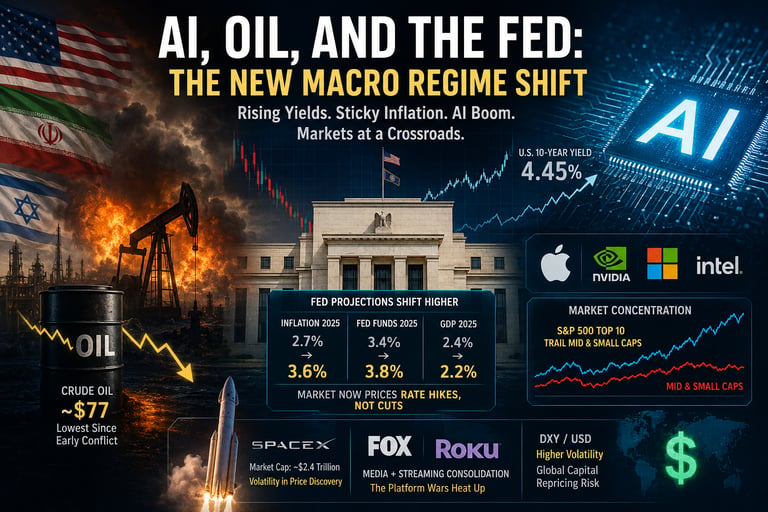
The most important shift last week came not from geopolitics, but from the Federal Reserve itself — specifically its updated projections. We are no longer in a “rate cut expectation” environment.
Key macro shifts inside the Fed outlook
US GDP forecast revised down (≈2.4% → 2.2%)
Inflation forecast revised sharply higher (≈2.7% → 3.6%)
Policy rate projections adjusted upward across 2026–2028
Market pricing shifted toward potential rate hikes, not cuts
The message is blunt: inflation is proving stickier than expected, and the Fed is preparing for structural persistence rather than transitory disinflation.
Long-end yields responded immediately:
US 10-year Treasury moved toward ~4.45%
Term premium is quietly rebuilding
Duration risk is back on the table
This is not the environment investors were positioned for six months ago.
Equities: Liquidity Is Still King, But Narrower Than Ever
Despite macro tightening signals, US equities remain resilient — but increasingly concentrated.
Market performance snapshot
S&P 500: +1.6% weekly, double-digit gains year-to-date
Nasdaq 100: +3.6% weekly, +20%+ YTD
Semiconductor index: +10% weekly, +100%+ YTD
The market is not rising broadly — it is being carried.
The AI Chip Supercycle: Demand Is Breaking Supply Models
The strongest structural force remains AI infrastructure demand. The evidence suggests a supply bottleneck, not just a demand boom:
Semiconductor shortages continue to tighten global supply chains
AI workloads are accelerating capex cycles across Big Tech
Memory chips are becoming the new strategic constraint
Corporate ripple effects
Apple faces rising input costs from chip scarcity
Price increases on future iPhone cycles are being discussed internally
Strategic alignment with Intel signals a partial reshoring of chip dependency
Intel has experienced sharp re-rating momentum on AI supply chain relevance
Apple and Intel are effectively adapting to a world where chip allocation, not demand, is the limiting factor. This is no longer just a tech cycle — it is an industrial constraint cycle.
Mega-Cap Concentration: The Market Is Getting Expensive in the Same 10 Names
One of the most under-discussed signals is valuation dispersion.
Mega-cap tech trades at significantly higher multiples than mid and small caps
Smaller companies remain comparatively undervalued
Capital continues rotating into perceived “safe growth monopolies”
The result is a structural imbalance:
Index performance is strong
Breadth is weak
Opportunity is increasingly hidden outside the top 10 names
This is the kind of setup that works… until it doesn’t.
SpaceX: Private Market Valuations Enter Public Market Psychology
The recent trading debut of SpaceX has introduced a new volatility regime into already stretched risk appetite.
Price action reality check
Initial trading range: sharp surge post-launch
Peak enthusiasm: +30% intraday expansion
Subsequent drawdown: ~15% from highs
Market cap narrative: trillions-level valuation discourse
The critical issue is not whether SpaceX is transformative — it is. The issue is pricing. A boots-on-the-ground perspective reveals a familiar pattern:
Private market narrative gets compressed into public market liquidity
Price discovery becomes sentiment-driven, not cash-flow driven
Volatility increases as institutional anchoring is absent
This is not a traditional IPO dynamic — it is a narrative asset entering liquid markets.
Media and Tech Convergence: Streaming Consolidation Returns
A reported strategic acquisition involving Fox Corporation and Roku reflects a broader theme:
Traditional media is aggressively repositioning into streaming infrastructure
Distribution platforms are becoming more valuable than content libraries
Hardware + software integration is returning as a strategic priority
The market reaction was predictable:
Short-term volatility
Long-term consolidation expectations
We are seeing the streaming wars evolve into platform wars.
The Macro Contradiction: Tightening Rates, Expanding Risk Appetite
This is the core paradox:
The Fed is signaling higher-for-longer (or even higher)
Long-term yields are rising
Inflation forecasts are moving up
Yet equity risk appetite remains aggressive
This divergence is not sustainable indefinitely. Either:
Growth justifies valuations (AI productivity boom), or
Liquidity reprices risk assets downward
There is no neutral outcome in this configuration.
Final Thought: This Is a Market Built on Narrative Compression
We are in a regime where:
Geopolitics drives energy shocks
Energy drives inflation expectations
Inflation drives rates
Rates collide with AI-driven equity concentration and through it all, liquidity keeps selecting the same winners.
A disciplined investor should not confuse momentum with stability. The system is working — until one of these feedback loops breaks.
Book Recommendation
For investors trying to understand how macro cycles, liquidity, and geopolitics intersect with markets, a strong fit is:
“The Alchemy of Finance” by George Soros
It is one of the few works that treats markets not as equilibrium systems, but as reflexive, unstable narratives — which is exactly the regime we are currently in.