
AI Bubble or Economic Revolution? How Big Tech’s Massive Spending Could Trigger the Next Global Financial Crisis
Artificial intelligence is driving Wall Street to record highs, with companies like NVIDIA, Microsoft, Amazon and Meta Platforms investing billions into AI infrastructure, chips and data centers. But are investors witnessing the next industrial revolution — or the formation of a dangerous financial bubble? Explore how AI, energy, geopolitics, Big Tech valuations and global markets are becoming deeply connected in the new economic era.
5/10/20265 min read
AI Bubble or the Next Industrial Revolution? Why Investors Are Divided on the Future of Artificial Intelligence
The global financial market is once again being driven by a technological revolution. This time, the catalyst is artificial intelligence. From Silicon Valley to Wall Street, investors are pouring billions into AI infrastructure, semiconductors, cloud computing, data centers, and machine learning platforms. Companies like NVIDIA, Microsoft, Amazon, Alphabet, Meta Platforms, and startups such as OpenAI and Anthropic have become the center of a new global economic race.
But a critical question is now dominating financial discussions: are we witnessing the birth of a long-term technological transformation, or the formation of a dangerous AI bubble similar to the dot-com crash of 2000?
The AI Boom Is Reshaping Global Markets
Over the past few years, AI-related stocks have experienced explosive growth. The American stock market, particularly the Nasdaq, has been heavily influenced by investor optimism surrounding artificial intelligence. Semiconductor giants and cloud computing companies have seen their valuations skyrocket as businesses rush to integrate AI into nearly every industry.
At the same time, cryptocurrencies like Bitcoin have surged alongside tech stocks, fueled by liquidity, speculation, and growing appetite for high-risk assets.
This optimism has pushed stock indexes toward record highs, but not everyone believes the rally is sustainable.
Why Some Analysts Believe an AI Bubble Is Forming
One of the biggest concerns among market analysts is the extreme concentration of market value in a small group of technology companies. Today, a significant portion of major U.S. indexes is heavily dependent on a handful of AI-driven corporations.
Historically, this type of concentration has often appeared before major financial corrections.
The current environment shares similarities with previous speculative periods, including:
The railway bubble of 1835
The dot-com bubble of the early 2000s
The 2008 financial crisis driven by excessive leverage and unrealistic valuations
The concern is not that artificial intelligence lacks real-world value. On the contrary, AI is already transforming industries, improving productivity, automating tasks, and changing how companies operate.
The real issue is valuation. There is a growing gap between the practical utility of AI technology and the prices investors are willing to pay for AI-related stocks.
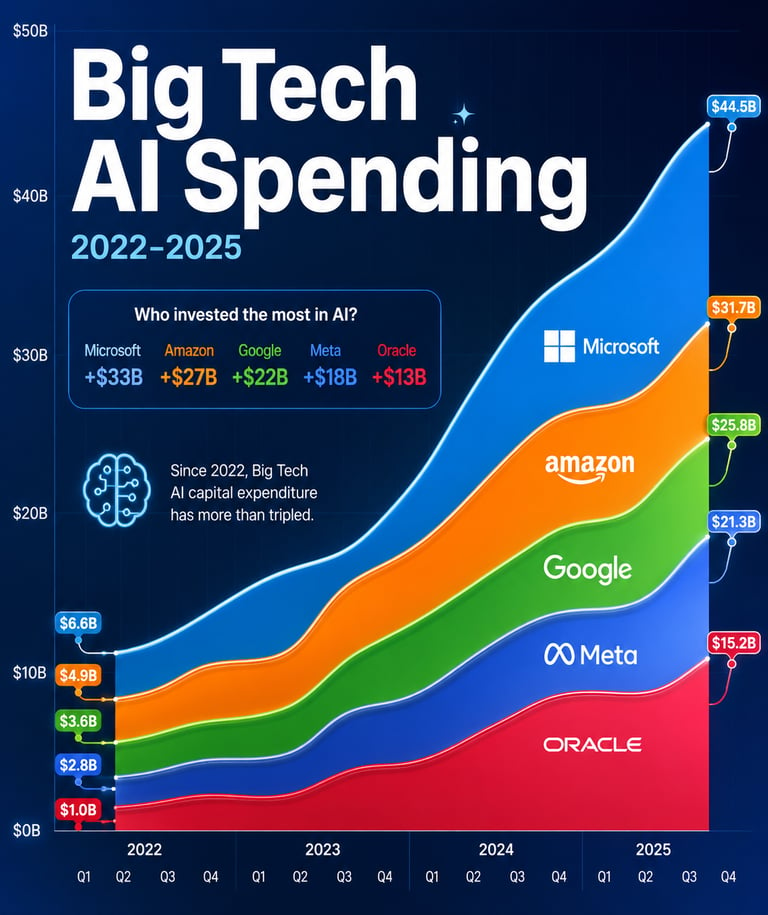
The $600 Billion AI Gamble
Major technology firms are investing enormous sums into AI infrastructure. Billions are being spent on:
Advanced semiconductors
Massive data centers
Cloud computing expansion
AI model training
Energy infrastructure
Cybersecurity systems
However, despite this unprecedented spending wave, many companies still struggle to demonstrate meaningful monetization.
The market is effectively pricing in a future where AI dramatically increases corporate profitability. But investors are starting to ask whether current revenue growth can realistically justify these massive valuations.
This is especially relevant for companies racing to avoid being left behind in the global AI competition.
Why NVIDIA Became the Symbol of the AI Era
No company better represents the AI boom than NVIDIA. Its GPUs became essential for training advanced AI systems, turning the company into one of the most influential players in global markets. NVIDIA’s stock performance has become a thermometer for investor confidence in artificial intelligence.
But this dominance also creates systemic risk. If one or two major AI companies disappoint investors with weaker-than-expected earnings, the impact could spread rapidly across the broader market due to the heavy concentration of capital in the sector.
AI and the Labor Market: Productivity or Mass Layoffs?
Artificial intelligence is already transforming the workforce. Executives across multiple industries face a difficult dilemma:
Should companies reduce staff and automate operations?
Or should they use AI to improve employee productivity?
Several major corporations, including Oracle and Meta Platforms, have announced large-scale layoffs in recent years, intensifying concerns about automation-driven unemployment.
At the same time, AI tools are increasingly capable of generating articles, analyzing data, writing code, and automating repetitive business tasks.
This creates uncertainty for workers while also opening opportunities for companies able to integrate AI efficiently.
High Oil Prices and the Global Economy
Another major factor influencing markets is energy.
Rising oil prices continue to create inflationary pressure worldwide. Transportation companies, airlines, logistics providers, and manufacturing industries all suffer when energy costs remain elevated for extended periods.
Higher fuel prices also influence consumer behavior.
In the United States, expensive gasoline has accelerated interest in electric vehicles, especially in states where long driving distances make fuel savings more attractive. Consumers with home solar systems and charging infrastructure are increasingly viewing EVs as an economic decision rather than just an environmental one. Companies like BYD and Tesla are benefiting from this transition.
Why Energy Is Becoming a Strategic Asset
The AI revolution requires enormous amounts of electricity.
Data centers, semiconductor production, cloud infrastructure, and AI model training consume massive energy resources. As a result, countries capable of producing abundant and affordable electricity may gain a significant competitive advantage in the coming decade.
Some analysts argue that nuclear energy could become strategically important again.
They often point to Germany’s post-nuclear energy challenges as an example of how expensive energy can weaken industrial competitiveness.
Meanwhile, countries like Brazil are attracting increasing levels of Chinese investment across sectors such as:
Mining
Electric vehicles
Clean energy
Infrastructure
Technology
Chinese companies are expanding aggressively in Latin America, particularly through projects tied to energy and industrial supply chains.
The Hidden Risk Behind AI Optimism
One of the most important lessons from past bubbles is that revolutionary technologies can still become terrible investments if investors overpay.
The internet transformed the world after 2000 — but many internet stocks still collapsed because expectations became detached from reality.
The same risk exists with artificial intelligence today.
The technology itself is real.
The productivity gains are real.
The infrastructure demand is real.
But the market may already be pricing in decades of future growth. That leaves little room for disappointment.
Could the AI Bubble Deflate Slowly Instead of Crashing?
Unlike previous market crashes, some analysts believe the AI sector may not collapse suddenly.
Instead, the market could experience a gradual “deflation” process where investors slowly become more demanding about profitability, cash flow, and real monetization.
This would not necessarily end the AI revolution. It would simply force companies to prove that their enormous investments can generate sustainable long-term returns.
For investors, this means caution and diversification may become increasingly important.
The Geopolitical Dimension of Artificial Intelligence
Artificial intelligence is no longer just a business trend — it is now a geopolitical competition.
The United States and China are engaged in a technological race involving:
Semiconductor dominance
AI infrastructure
Rare earth minerals
Energy security
Chip manufacturing
Supply chain control
Restrictions on advanced chip exports have also created growing concerns about chip smuggling and technology leakage into sanctioned markets.
As AI becomes more critical to military, industrial, and economic power, technology is increasingly becoming a strategic national asset.
Final Thoughts: Opportunity and Risk Can Exist Together
Artificial intelligence may ultimately become one of the most transformative technologies in modern history.
But history also shows that markets often become irrational during periods of technological excitement.
The current AI boom combines several classic warning signs:
Extreme optimism
Massive capital concentration
High valuations
Speculative private funding rounds
Unclear profitability for many companies
At the same time, ignoring AI completely could mean missing one of the biggest economic transformations of the century.
For long-term investors, the challenge is finding balance between participating in innovation and avoiding excessive exposure to speculative hype.
The next few years will likely determine whether today’s AI leaders justify their extraordinary valuations — or whether the market eventually forces a painful reset.
Recommended Book
For readers interested in understanding financial bubbles, market psychology, and speculative manias throughout history, one of the best books to explore is Extraordinary Popular Delusions and the Madness of Crowds.
The book offers timeless lessons about investor behavior, speculative excess, and why financial euphoria repeatedly appears across different eras — from railway bubbles to the modern AI boom.
Link: https://amzn.to/4wtdiIX