
8 April Stock Market Rally Explained: Was It Really Geopolitics or a Technical Market Squeeze?
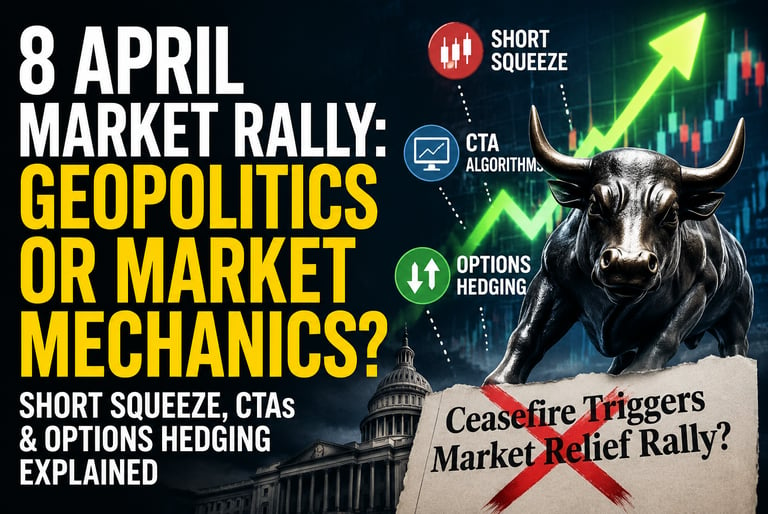
The 8 April stock market rally is widely described as a geopolitical relief rally, but market structure analysis suggests it may have been driven by short squeeze dynamics, CTA algorithms, and options dealer hedging rather than news events.
5/8/20263 min read
Introduction: Why the Market Rally Narrative May Be Misleading
The sharp stock market rally on 8 April was quickly attributed by financial media to optimism surrounding a reported geopolitical ceasefire. This explanation created a simple narrative: peace leads to rising markets.
However, modern market structure analysis suggests a more complex reality. Instead of being driven by geopolitical developments, the rally may have been the result of mechanical trading flows, including short covering, algorithmic buying, and options market hedging.
Understanding this distinction is critical for investors trying to interpret today’s equity market behavior.
Key Question: What Really Caused the 8 April Stock Market Rally?
While headlines focused on geopolitics, several market indicators pointed to internal structural pressures:
Extremely high hedge fund short positioning before the rally
Record levels of leverage among institutional investors
Strong systematic selling prior to the price reversal
Large exposure to derivatives and options positioning
These conditions created an environment where even modest price increases could trigger forced buying.
Short Squeeze Explained: The Primary Catalyst Behind Market Moves
One of the most important drivers of the rally was a short squeeze.
What is a short squeeze in the stock market?
Short Squeeze=Forced Buybacks+Rising Prices+Margin Pressure\text{Short Squeeze} = \text{Forced Buybacks} + \text{Rising Prices} + \text{Margin Pressure}Short Squeeze=Forced Buybacks+Rising Prices+Margin Pressure
A short squeeze occurs when investors betting against the market are forced to repurchase stocks as prices rise, often at a loss.
How a short squeeze develops:
Traders borrow and sell stocks expecting prices to fall
Prices rise instead of falling
Losses force buybacks to close positions
Margin calls accelerate the buying pressure
Additional buying pushes prices even higher
This creates a feedback loop where buying triggers more buying, independent of news or fundamentals.
CTA Funds and Algorithmic Trading Impact on Stock Prices
Commodity Trading Advisors (CTAs) are systematic hedge funds that trade based on price momentum models rather than news or fundamentals.
Why CTAs matter in modern markets
When key price levels are broken, CTAs can rapidly shift from selling to buying.
This behavior creates:
Large-scale algorithmic repositioning
Momentum-driven buying waves
Amplified volatility in both directions
In the 8 April rally scenario, CTA strategies reportedly flipped from net short exposure to aggressive buying, accelerating upward price movement.
Options Market Hedging: The Hidden Driver of Volatility
Another major factor in modern equity markets is options dealer hedging.
When investors buy call options, dealers must hedge their exposure by purchasing the underlying stock.
Gamma hedging effect in simple terms:
Price Increase→Dealer Buying→More Price Increase\text{Price Increase} \rightarrow \text{Dealer Buying} \rightarrow \text{More Price Increase}Price Increase→Dealer Buying→More Price Increase
This creates a self-reinforcing cycle known as gamma-driven buying.
In highly active options markets, especially with short-dated contracts, this effect can significantly amplify stock market rallies.
Why the Stock Market Reacts Less to News Than Before
A key argument in modern market structure theory is that markets are increasingly driven by internal flows rather than external news.
Main structural drivers include:
Passive index funds (automatic capital allocation)
Algorithmic trading systems (rule-based execution)
Options market hedging (delta and gamma exposure)
Leveraged hedge funds (risk-model forced behavior)
Together, these systems can override traditional news-driven reactions.
The Role of Passive Investing and “Blind Money”
Passive investing now represents a large share of equity market flows.
These funds:
Do not analyze company fundamentals
Do not react to geopolitical events
Allocate capital based purely on index weighting
This creates what some analysts call “blind money” — capital that flows mechanically regardless of external conditions.
Market Concentration: The Impact of Mega-Cap Stocks
Another important factor is index concentration. A small group of large technology companies now dominates major indices like the S&P 500. Because passive funds allocate based on market capitalization:
The largest companies receive the most inflows
Their price movements disproportionately affect index performance
Market direction becomes increasingly dependent on a few stocks
This increases systemic sensitivity to mechanical flows rather than broad economic signals.
Why Markets Can Look “Disconnected” From Reality
The combination of:
Short squeezes
Algorithmic trading systems
Options hedging flows
Passive investment allocation creates a structure where markets can move sharply without clear fundamental justification.
This often leads to the perception that markets are behaving irrationally, when in fact they are reacting to internal structural mechanics.
Conclusion: Was the 8 April Rally Really About Geopolitics?
While geopolitical headlines may have provided a convenient explanation, the evidence suggests the 8 April stock market rally may have been primarily driven by:
Short squeeze dynamics
CTA systematic buying
Options dealer hedging activity
High leverage positioning in hedge funds
In this framework, news does not necessarily cause market moves — it often serves as a narrative used to explain movements already driven by market structure.
For investors, this raises an important question: Are we still trading the economy, or are we trading the mechanics of the market itself?