
3 Stocks Quietly Dominating AI, Chips, and Global Payments
Wall Street analysts continue highlighting a select group of U.S. companies positioned to benefit from the long-term expansion of artificial intelligence, semiconductor infrastructure, and digital payments. Despite recent market volatility, firms like ANET, ARM, and V are still viewed as strong long-term opportunities thanks to their dominant market positions, scalable business models, and growing global relevance.
5/9/20265 min read
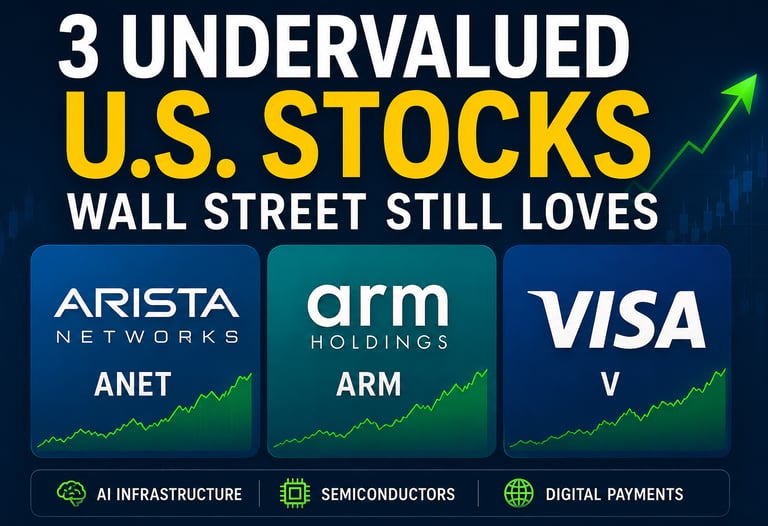
3 Undervalued U.S. Stocks Wall Street Still Loves
Despite ongoing market volatility in 2026, several major U.S. companies are still attracting strong bullish sentiment from Wall Street analysts. While investors remain focused on inflation, AI spending, semiconductor competition, and regulatory pressure, some stocks are now trading at discounts that long-term investors are closely watching.
Three companies stand out in particular:
Arista Networks (NYSE: ANET)
Arm Holdings (NASDAQ: ARM)
Visa (NYSE: V)
Each operates in a different sector, but all three sit at the center of powerful long-term global trends: artificial intelligence, digital infrastructure, and electronic payments.
Here’s why Wall Street still sees upside potential in these companies — and why they could become some of the most important long-term investment opportunities of 2026.
Arista Networks (ANET): The AI Infrastructure Giant Quietly Beating Cisco
ANET
Arista Networks has become one of the biggest winners of the artificial intelligence boom, even though many retail investors still underestimate the company’s importance.
The company builds high-performance networking infrastructure used inside modern data centers. In simple terms, Arista creates the digital “highways” that allow servers and AI systems to communicate with each other at massive speeds without congestion.
As AI models become larger and more computationally demanding, the need for faster and more efficient networking hardware continues to explode.
That is where Arista has been taking market share aggressively.
Why Arista Is Beating Cisco
One of Arista’s biggest competitive advantages comes from software efficiency.
While Cisco still relies on multiple operating systems across different hardware products, Arista built a unified operating system architecture that runs across its entire networking ecosystem.
This simplified approach improved scalability, operational efficiency, and deployment speed for enterprise customers and hyperscale data centers. By 2023, Arista had already surpassed Cisco in several areas of the data center networking market.
Why the Stock Fell in 2026
Despite strong earnings, Arista shares dropped nearly 17% after recent results due to supply chain bottlenecks.
Importantly, the issue is not weak demand.
The company continues to experience strong customer interest driven by AI infrastructure spending, but manufacturing and supply constraints have created concerns about near-term revenue delivery.
For long-term investors, this distinction matters.
Wall Street analysts still believe the company has significant upside potential, with some price targets implying more than 30% upside over the coming months.
Why Investors Are Bullish on Arista
Several factors continue supporting the bullish thesis:
Explosive AI data center demand
Strong revenue growth
Expanding profit margins
Debt-free balance sheet
Growing software and services revenue
Increasing dominance in cloud networking
In many ways, Arista is becoming one of the core infrastructure providers behind the global AI race.
Arm Holdings (ARM): The Company Behind Almost Every Modern Chip
ARM
Few companies are more important to the global semiconductor industry than Arm Holdings.
Unlike Nvidia, Intel, or AMD, ARM does not primarily manufacture chips. Instead, the company designs the fundamental chip architectures used by nearly every major technology company on the planet.
Apple, Qualcomm, Nvidia, Samsung, and countless others rely on ARM-based designs.
According to analysts, ARM architecture powers more than 99% of the world’s smartphones.
Why ARM’s Business Model Is So Powerful
ARM operates one of the most scalable business models in the semiconductor industry.
The company makes money in two main ways:
1. Royalties
Every time a chip using ARM architecture is sold, ARM receives a percentage of the sale.
This creates a massive recurring revenue stream tied to global semiconductor demand.
2. Licensing
ARM also licenses its architectures directly to technology companies for large upfront payments.
This allows customers to build customized chips without developing entire architectures from scratch.
The result is a highly profitable model with lower manufacturing risk and enormous scalability.
ARM’s Growing Role in Artificial Intelligence
ARM is no longer just a smartphone company.
The company is now expanding aggressively into AI servers and data centers, areas expected to become some of the fastest-growing sectors in global technology spending over the next decade.
As AI infrastructure spending accelerates worldwide, ARM is positioning itself as a foundational layer of next-generation computing.
The Main Risk Investors Should Watch
While Wall Street remains optimistic about ARM’s long-term future, analysts also acknowledge that the stock carries higher risk than some competitors. Shares surged more than 95% over the past year, meaning valuation expectations are already elevated.
The company remains deeply tied to the current AI enthusiasm cycle, which increases volatility if sentiment around AI stocks weakens.
Still, many investors believe ARM’s dominance in semiconductor architecture makes it one of the most strategically important tech companies in the world.
Visa (V): The Quiet Compounder Facing Regulatory Pressure
Visa may not generate the same excitement as AI stocks, but it remains one of the strongest business models in global finance. The company operates as the invisible infrastructure behind electronic payments worldwide. Importantly, Visa does not lend money directly and does not issue credit itself.
Instead, it processes transactions between banks and financial institutions — collecting fees while avoiding most credit risks.
That business model has allowed Visa to maintain extremely high profit margins, often exceeding 50%.
Why Visa Avoids Credit Risk
One of Visa’s greatest strengths is structural simplicity. If a customer defaults on a credit card payment, the bank absorbs the loss — not Visa. Visa still earns revenue from processing the transaction itself.
This creates a highly scalable business with:
strong free cash flow
low operational risk
global network effects
recurring transaction revenue
Why Visa Stock Fell in 2026
Visa shares declined roughly 8% during 2026 amid increasing regulatory scrutiny in both the United States and Europe.
Governments and regulators continue examining the dominance of the Visa-Mastercard payment duopoly, while newer technologies such as cryptocurrencies and direct digital payment systems create long-term competitive questions. However, Visa’s core fundamentals remain extremely strong.
Why Wall Street Still Likes Visa
Analysts continue viewing Visa as one of the safest long-term compounders in the market because of:
Massive international presence
Premium global brand
High margins
Consistent revenue growth
Strong pricing power
Global digital payment expansion
Wall Street price targets currently suggest meaningful upside potential over the coming months. For many investors, Visa represents a defensive technology stock capable of performing even during uncertain macroeconomic periods.
The Bigger Picture: AI, Infrastructure, and Global Financial Power
What makes these three companies especially interesting is that they represent different layers of the modern global economy.
Arista powers AI infrastructure
ARM powers semiconductor architecture
Visa powers global digital commerce
Together, they reflect some of the most important economic trends shaping the next decade:
artificial intelligence
data center expansion
semiconductor dominance
digital payments
financial infrastructure
technological geopolitics
While short-term volatility remains high in 2026, many investors are increasingly focusing on companies with strong balance sheets, scalable business models, and durable competitive advantages. That is exactly why Wall Street continues watching these stocks closely.
For investors looking to better understand how dominant companies build long-term competitive advantages, one highly recommended read is Chip War: The Fight for the World's Most Critical Technology. The book explores how semiconductors, artificial intelligence, and geopolitical competition are reshaping the global economy — themes directly connected to companies like ARM and ANET. It also provides valuable context on why chip architecture and technological infrastructure have become strategic assets in the modern world.
Link: https://amzn.to/4njIztp